20th Anniversary: Malcolm Combe’s Time as a Student Advisor

By Malcolm Combe


I was an undergraduate law student at Strathclyde from 2001-2005. Whilst I had no idea this would be the case when I enrolled, being a student at this time put me in a fortunate position: I was able to join the first intake of student volunteers at the new-fangled University of Strathclyde Law Clinic.

I confess I had never even heard of a law clinic when Donald Nicolson sought recruits for the initiative he was setting up at Strathclyde. Like many other enthusiastic students though, I took the plunge and got involved. After an initial period as an advisor, I then become Firm Manager of one of the three firms the Clinic was (at the time) divided into. I continued my involvement with pro bono legal advice in various capacities in the years that followed, before eventually returning to Strathclyde Law School as an academic in 2019. That allowed me to rekindle my support of the Law Clinic in a number of ways, and in the past couple of years I have acted as Programme Director of the Clinical LLB: a dedicated programme for students who embed law clinic experiences and insights into a law degree. It seems fitting that I have somehow found my way back to the Law Clinic, and I’m delighted to be able to contribute to this 20th anniversary celebration of it.

One particular memory of the clinic involves Donald and I going to the old BBC studios at Queen Margaret Drive for a radio interview. For which station I cannot recall, and whether this ever made the airwaves I am not sure; I suspect it did not. Somewhere though, there may be an archive tape where I can be heard adopting the word “worthwhile” as my most favourite word ever, and I am only grateful that BBC Sounds wasn’t around to capture this for more public posterity. Anyway, Donald and I tried to speak about why the law clinic was needed, and also how shocking it was that there was such a demand for it given the unmet legal need that was being plugged by students rather than another source of legal advice and support. Maybe we got a bit too political and that is why we were never broadcast. Alas, what we spoke about remains relevant today. I do fundamentally believe in clinical legal education, and it has become part of my practice; whether it should form so much of a societal safety valve is another matter though.

There were plenty of other good memories of my time with the law clinic, particularly in the context of making friends and attending social events. I also have fond memories of making a difference for clients who came in for advice, which leads on to my memory of my most nerve-wracking moment in the clinic…

Prior to 2011, tenancy deposit protection was not a thing in Scots law. Landlords could ask their tenants for a deposit of up to two months’ rent, but what they did with that deposit was not particularly regulated, and in the event of a dispute at the end of the tenancy there was no state-backed scheme available to adjudicate that dispute. Jennifer Wallace and I represented a client who was seeking the return of their deposit, which their landlord was seeking to retain or at least deduct a sum of money from, apparently on the basis of the condition of the let property. We duly trotted to Glasgow Sheriff Court after serving the paperwork in relation to this, only to discover in court that the documents our client had presented to us were not the full story. Cue a massive flap and a hasty oral submission about some point of law that I was absolutely winging. We managed to push matters into a further hearing though, and our client was in the end awarded the full deposit. Incidentally, this case remains my only appearance representing a client in the Scottish court system: I am delighted to note my 100% success rate as a litigator, and the clinic’s contribution to that record.

Being in the Clinic taught me quite a lot, or at least forced me to be more structured in my application of previously abstract ideas. In addition to mundane skills like task management and keeping organised files, the clinic brought notional scenarios to life. Suddenly I was faced with real people with real problems, and I was determined to do my best for them. I hope I did justice to the faith they put in me, and perhaps contributed just a little to the access to justice deficit that existed at the time.

Speaking of which, access to justice issues have not gone away. In fact, they have probably got worse. My message to the current crop of law clinic students is accordingly a simple one – keep striving to make a difference. Also, keep in mind that even if some aspects of your clinic journey might feel a bit hectic or overwhelming when you are in the moment, what you are doing is indeed worthwhile. You are still doing the right thing by putting yourself in those situations. My overwhelming perception of those who have been involved with the clinic is that they look back on their time there with both fondness and an awareness about how it has contributed to their own self-development, not to mention it has allowed lasting friendships to be formed along the way. Here’s to the next twenty years!
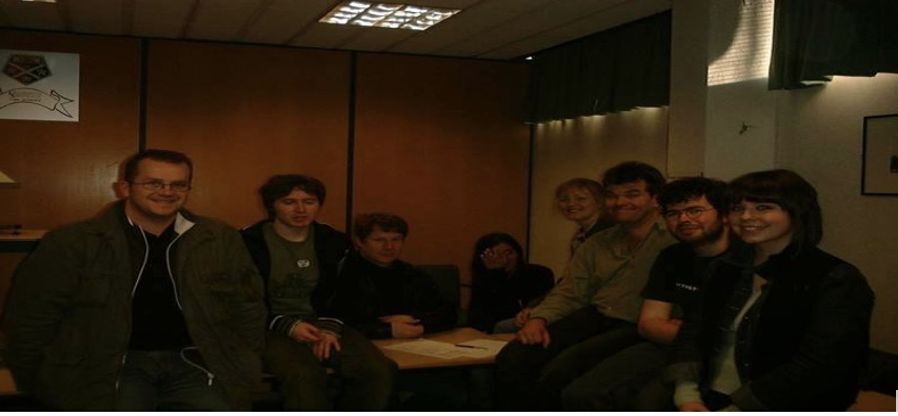

 

Law Clinic volunteers in the ground floor of the (now demolished) Stenhouse Building, the site of the Clinic’s first office. Malcolm is second from the right.

Mediation and Restorative Justice

by Katy Li

In March 2023, I attended the third UK Mediation Clinic Conference at the University of Strathclyde. In my Scots Law CLLB degree, I have encountered mediation in the Legal Methods module, and during workshops as a part the clinical degree.

During my initial law clinic training, we were taught to produce client statements by sifting through the legally non-relevant information from client interviews. In practice, particularly when dealing with vulnerable clients, it often takes time for them to get their stories out. I do not enjoy hearing the voice inside my head going:When will you get to the relevant part?’ as I interview someone who is struggling to communicate their thoughts.

The tug between fully listening and understanding the client on a person-to-person level, and filtering out the information they give me as legally relevant or non-relevant on the spot has caused some tension in me. In mediation, the emphasis on listening to both parties and helping them to put their stories across seem to provide a space where creative solutions can be found. People’s emotions, what they really desire, and how they want to be treated, take on more significance in mediation than in traditional solicitorclient relationships.

Mediation is particularly suitable for situations where parties wish to maintain a relationship in the future. On the other hand, where there is a power imbalance between the parties, mediation may not be appropriate. I took this impression with me when I attended a restorative justice seminar on ‘How can Active Victim Participation be Achieved?’ by Prof Tim Chapman in June 2023. Restorative justice is about bringing the perpetrator and victim together for the benefit of both. The seminar focused on sexual abuse cases. Examples of the victims bravery and strength to participate in the sessions and to hold perpetrators responsible were remarkable. It also made me angry for the institutional failures that allowed children to be abused by people in positions of authority.

Prof Chapman mentioned that some victims are ‘vulnerable but strong’, meaning that some are willing to expose themselves to past trauma (past in the sense that the event happened in the past, but the effects of which are still very much present) at the price of being triggered and emotionally exposed as a part of their healing journey. Whilst some practitioners might say: ‘Meeting the perpetrator at the place of abuse will re-traumatise you, the risk is too great’, if the victim has requested this, and if it is appropriate, it takes a brave practitioner to assist the victim to go where they need to go, even to those dark and difficult places.

It is not lost on me that to hold meetings between parties with such complicated history requires immense skill, time and planning to safely facilitate, and resources are limited; however, where this is possible, the potential for healing is also great.

Being fully present and patient are throughlines in mediation and restorative justice. As a student advisor, it reminds me that how we deliver advice is just as important as the advice we give.

More details of the conference can be found here: https://www.strath.ac.uk/media/1newwebsite/departmentsubject/law/Mediation_Matters_-_Issue_3_-_April_2023.pdf

Pride Month 2023 – Celebrating Difference & Challenging Discord

by Corey Beaton

It was fortunate that my first day as EDI Officer for Strathclyde Law Clinic fell on the first day of Pride Month 2023. Plenty of events will be held across Scotland to celebrate its LGBTQI+ communities, to campaign for stronger protections for equal rights, and to reflect on the challenges which are still faced across the country and the world.

Fifty-four years have passed since the Stonewall protests took place in New York; 51 years ago in July, the UK’s first Pride March danced and celebrated its way through the streets of London; and 20 years have passed since section 28 of the Local Government Act 1988 was finally repealed. All significant milestones in the growth of the vibrant and diverse Pride Movement across the world, but this is growth which continues to be tempered by the continuing harassment and persecution of LGBTQI+ people across the world.

In March this year, the Ugandan Parliament passed a bill which made so-called “aggravated homosexuality” punishable by death, or at the very least life imprisonment. Closer to home, the Scottish Government reported that, in 2021-22, almost 7,000 hate crimes were reported to police with over a quarter being motivated by prejudices against another’s sexual orientation and gender identity. When we look back at the words of Hillary Clinton in 2010, that “gay rights are human rights and human rights are gay rights once and for all”, it’s clear to see this message hasn’t been shared as widely nor acted on as positively as she had hoped.

That is not to say there is no hope, no recourse of action, that we can undertake as individuals nor as a collective. The rule of law has always proven itself to be an invaluable & effective vehicle for change; it’s only when those processes are abused does it cause harm and suffering. We’ve come a long way in Scotland to make sure our LGBTQI+ communities are given equal rights & opportunities, but we shouldn’t stop there – there is simply too much at stake to allow discord & hate to become the norm.

I wish everyone who celebrates it a happy and safe Pride Month, and never stop believing that fighting for what’s right is worth it.

Clinic Turns 20: Alumni Invitation

Dear Law Clinic Alumni,

As you may know, the Clinic turns 20 this year!

We are organising an event in celebration of this where current and past advisors are invited! This is planned to take place on the evening of Thursday the 21stSeptember 2023.

The event will focus on access to justice and with particular focus on gaps in legal representation. We hope to focus on the areas of employment, SSSC and immigration, as these are three large areas that the Clinic works in.

We will provide more details about the event as time goes on. Eventually an Eventbrite page will be set up to register for tickets to the event so please keep an eye out for this. For now, please pencil the 21st September into your diaries to ensure you are free to come along!

We would love to have as many alumni there as possible so please talk about this with other alumni that you know to make sure they know about it!

We look forward to hopefully seeing you on the 21st September 2023.